






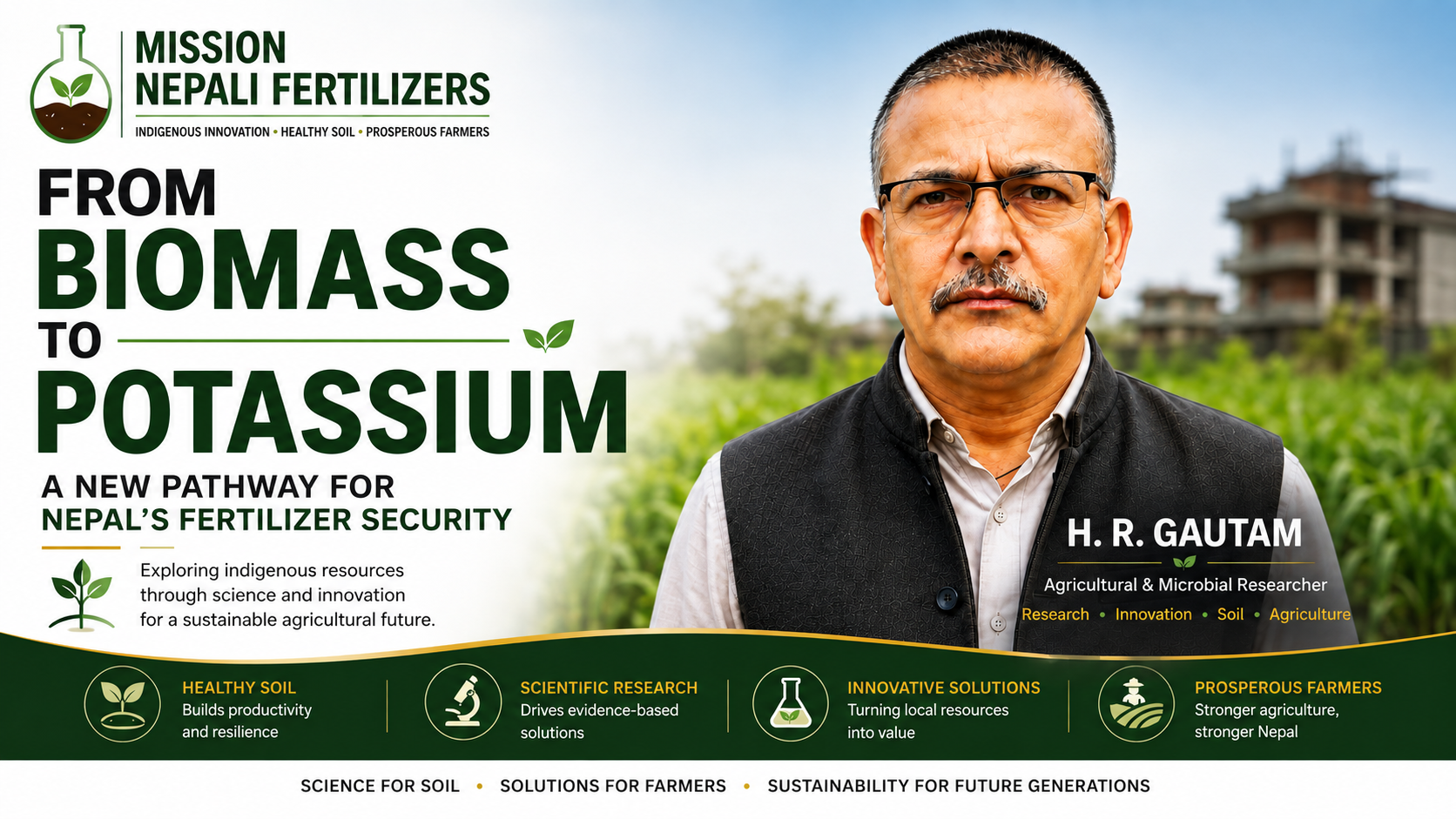
Can locally available biomass become a new source of potassium for Nepalese agriculture?
Nepal’s fertilizer story has largely been a story of dependence. Every year, farmers wait for imported fertilizers to arrive, while prices, international supply chains and geopolitical uncertainties continue to influence availability and affordability. Nitrogen and phosphorus fertilizers receive much of the attention, but potassium is equally important for maintaining healthy crops, improving water regulation, strengthening plants against stress and supporting yield and quality.
This raises an important question:
Can Nepal develop part of its potassium requirement from its own biological resources? The answer may not be immediate, but it is certainly worth investigating.
Biomass: From Waste to Resource
Nepal produces large quantities of biomass from agriculture, vegetation and aquatic environments. Much of this material is either left unused, burned, dumped or treated simply as waste.
But biomass is not merely waste. It contains organic matter as well as mineral nutrients absorbed during plant growth. Among these nutrients, potassium can be particularly important.
This creates an interesting possibility: instead of allowing nutrient-rich biomass to become an environmental burden, can we recover its useful mineral components and return them to agriculture?
This idea forms the basis of the proposed Biomass Potassium Initiative (BPI) under Mission Nepali Fertilizers.
The initiative proposes research into a technology platform known as Controlled Pyro-Alkaline Extraction (CPAE). In simple terms, the concept involves controlled thermal treatment of selected biomass followed by a carefully managed extraction process to recover useful potassium-containing material.
The purpose at this stage is not to claim that the technology is already a finished fertilizer solution. The purpose is to research, test, validate and improve the process.
Why Potassium Matters :
Potassium is sometimes described as a “quality nutrient” because of its important role in plant physiological processes.
Adequate potassium helps plants regulate water, activate enzymes, maintain photosynthetic activity and tolerate environmental stresses. It also contributes to crop quality, grain filling and overall plant strength.
Therefore, a reliable potassium supply is not simply a fertilizer issue. It is connected with crop productivity, resilience and food security.
If a portion of Nepal’s potassium requirement could eventually be supplied from locally available resources, it could provide an additional layer of national fertilizer security.
A Different Way of Looking at Biomass :
The proposed approach is also connected with the idea of a circular agricultural economy. In a conventional system, biomass is often produced, discarded and forgotten. In a circular system, useful components are recovered and returned to productive use.
A biomass-processing platform could potentially generate more than one useful output.
The primary target would be a potassium-based agricultural product. Depending on the feedstock and processing conditions, the system may also produce a carbon-rich solid material such as biochar and a condensed biomass-derived liquid fraction that may be further investigated for agricultural applications.
However, these potential co-products must not automatically be considered agricultural products. Their chemical composition, safety and agronomic suitability must first be established through laboratory and field testing.
That scientific caution is essential.
Research Must Come Beforei Commercialization :
One of the biggest mistakes in agricultural innovation is to move from an attractive idea directly to commercial production without sufficient validation.
The proposed BPI therefore places research first.
Before any large-scale fertilizer production is considered, the technology should be evaluated for:
Potassium recovery efficiency
Nutrient concentration and consistency
Heavy-metal and contaminant levels
Energy requirements
Production cost
Product stability and storage
Soil safety
Crop response
Environmental performance
Compliance with applicable fertilizer standards
Only after these parameters are scientifically established should the technology move towards wider agricultural use.
Can It Be Affordable for Farmers?
This is perhaps the most important question.
A locally produced fertilizer is not automatically a low-cost fertilizer. Processing, energy, equipment, quality testing, transportation and packaging all contribute to the final cost.
Therefore, the economic model must be designed around resource efficiency and scale. If locally available biomass can be obtained at low cost, energy consumption can be controlled, and several valuable products can be recovered from the same processing system, the overall economics may become more attractive.
This is precisely why pilot-scale research is necessary.
A pilot plant can answer questions that theoretical calculations cannot: How much biomass is required? How much potassium can actually be recovered? How much energy is consumed? What is the cost per kilogram? What happens to the remaining material?
These are the numbers that will ultimately determine whether the technology has commercial value.
From Research to Rural Enterprise
If successfully validated, biomass-based potassium recovery could eventually create opportunities beyond fertilizer production.
Local biomass collection could generate rural employment. Small and medium enterprises could participate in feedstock supply, processing, packaging and distribution. Research institutions could provide testing and quality assurance, while farmers could participate in field validation.
Such a model could transform biomass from a disposal problem into a local agricultural value chain.
However, the technology should first prove itself scientifically and economically.
A New Research Opportunity for Nepal
Nepal has often searched for solutions to fertilizer shortages outside its own borders. Imported fertilizer will continue to remain important for the foreseeable future, but long-term agricultural resilience requires additional solutions.
The question is therefore not whether Nepal can completely replace imported fertilizers overnight.
The more realistic question is:
Can Nepal gradually develop indigenous technologies that reduce its dependence on imported agricultural nutrients?
Biomass-based potassium recovery is one such possibility.
The proposed Biomass Potassium Initiative (BPI) aims to establish a research and pilot-production platform where this possibility can be tested scientifically.
The next step should be collaboration among agricultural researchers, laboratories, universities, government agencies, farmers and responsible private-sector innovators.
If laboratory results are promising, the work can move to greenhouse trials, multi-location field validation and eventually commercial-scale assessment.
The Opportunity Ahead
Nepal’s agricultural future will require more than increasing fertilizer imports. It will require better soil management, efficient nutrient use, recycling of local resources and investment in indigenous agricultural technologies.
Turning biomass into a potential source of potassium does not promise an instant solution. But it offers a research pathway that deserves serious attention.
The opportunity is simple to understand:
What if a material currently regarded as waste could become a source of agricultural nutrients?
That question deserves a scientific answer.
And if the answer proves positive, Nepal could gain not only another source of potassium, but also a new example of how indigenous resources, scientific innovation and sustainable agriculture can work together.
From Biomass to Potassium — From Waste to Agricultural Value.