






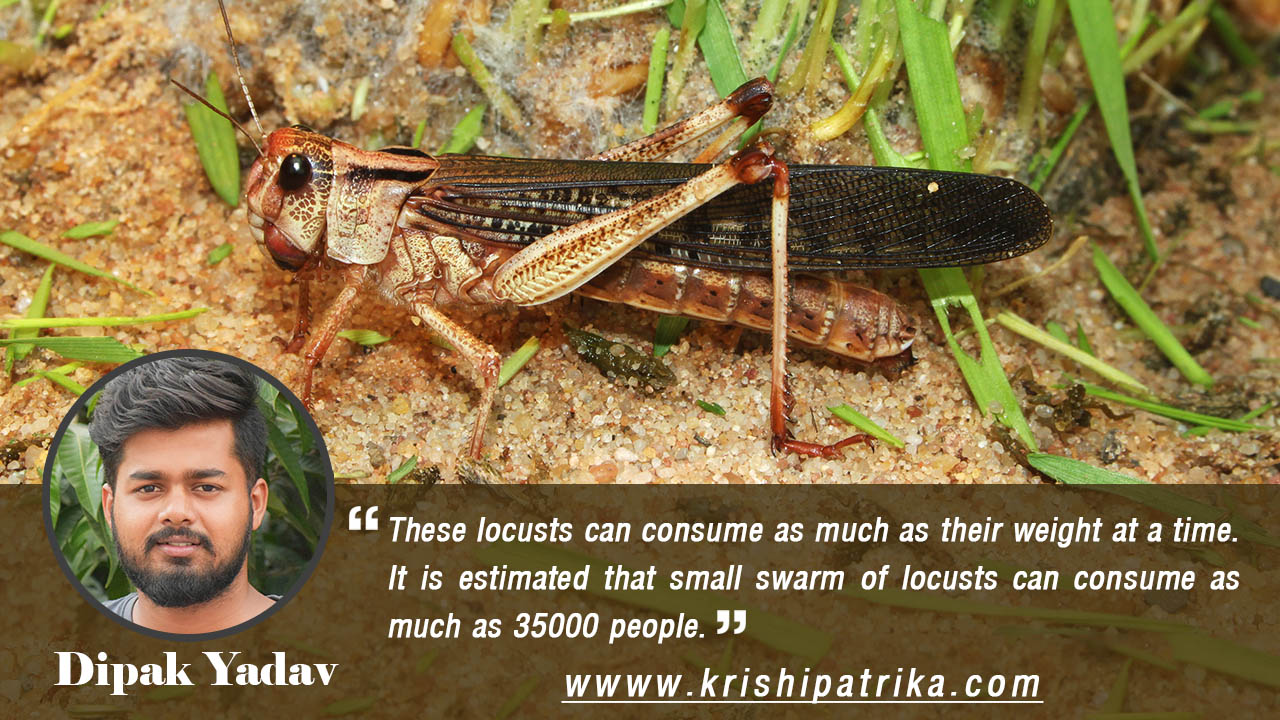
Locusts refer to the group of short-horned grasshoppers that often increase greatly in numbers and migrate long distances in destructive swarms. The names locust and grasshopper are used for any Acridid. They are usually solitary but under definite conditions, they develop into more copious and they change their behaviour and habits to become more gregarious. However, there is no taxonomic difference between them.
These grasshoppers which normally are harmless, their population is low and also they do not cause a foremost economic threat to agriculture. But when the circumstances are favourable such as when drought is followed by the rapid growth of vegetation, the behaviour of these insects changes because serotonin which is secreted in their brain sets off a vivid set of changes. They become gregarious and start to breed abundantly and make their populations dense enough.
There are 3 types of locust i.e.
- Bombay Locust: They are seen mainly in Gujarat & Tamilnadu. They breed once a year in open areas of Western Ghats and lay eggs.
- Migratory Locust: They are found mainly in Rajasthan & Gujarat. They lay eggs twice a year, during winter or spring in Pakistan and during summer or spring in Rajasthan or Gujarat.
- Desert Locust: These locusts cause severe damage than the above mentioned and can be the reason for famine. They are polyphagous insects. They can scoff all types of crops. These locusts can consume as much as their weight at a time. It is estimated that a small swarm of locust can consume as much as 35000 people. Female locusts, after mating, lay eggs after 8-24 hours. A single locust can lay about 500 eggs throughout their lifespan. They lay eggs deep in the soil about 10-15 cm.
Control: The foremost method of control can be done by the destruction of eggs but it is predicted that locusts cannot lay eggs in the prevalent soil condition of Nepal. They need loose sandy soil to lay their eggs. If the swarm are about to descend in the farm, the suitable method to prevent the crop from being eaten by them are by preventing them to dismount by a possible method such as waving a white cloth, or creating a cloud of smoke, by burning refuse, etc., spraying with neem kernel suspension as a deterrent to the crop. And when they are inactive or solitary during the night or early morning, they can be burnt by the help of flame thrower. If the number is relatively low they can be trapped easily by lighting a bulb at one side of the field and placing a tank of water beneath it. The locusts are attracted towards the source of light and fall in the tank causing them to die. The water can be mixed with neem kernel or leaves to be more effective.
Chemicals are found effective for controlling locust as they act faster. Chemicals such as 5% BHC or pairs green or sodium fluosilicate and dusting of 5 to 10% carbaryl or BHC twice against hoppers at the rate of 25 to 30kg/ha can bring complete control of the pests. Aerial application of Aldrin 4% is effective and easier because they cover a vast area in a relatively short time and also the swarms that are in flight can be treated.
Biopesticide is also used to control the locust. Fungi of Metarhizium acridum have been proven to be very effective in controlling the locusts. This biopesticide is formulated using the spores of the fungus. When spores come into contact with locust, they germinate & penetrate its cuticle. At that point, the fungus develops inside the body until it kills the insects. As the fungus develops it first give the locust a pink coloured tint & then cover its body with mycelium. Besides this, Beauveria bassiana, also known as Green Beauveria, can be used. It is sprayed over the plants at the rate of 5ml/l of water.
It is seen that people in Central Africa use physical methods to catch locusts and use them for stock feed.
Writer : Dipak Yadav (B.Sc.Ag(Hons.) 4th year, Banaras Hindu University, Varanasi, Uttar Pradesh )