






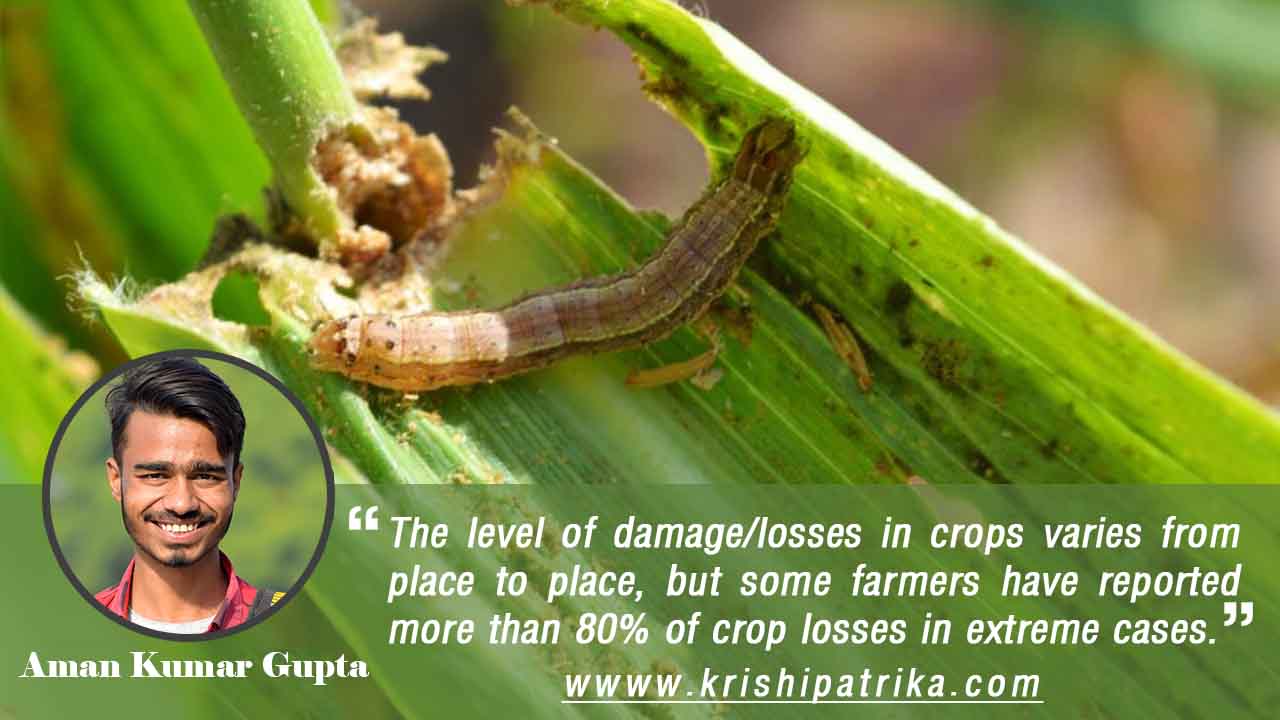
Fall Armyworm (FAW) is a polyphagous pest and native of America. The scientific name of FAW (Spodoptera frugiperda) was given by James Edward Smith in 1797. Frugiperda was derived from the Latin word, which means lost fruit. Spodoptera frugiperda belongs to Phylum – Arthropoda, Order- Lepidoptera, and Family – Noctuidae. In 2016, fall armyworm was first reported in Africa. The arrival of fall armyworm in Nepal was declared by Plant Quarantine and Pest Management Centre (PQPMC) in August 2019. It is a very harmful pest of maize and also attacks sorghum, sugarcane, soybean, alfalfa, tomato, onion, cotton, and many other vegetable crops. In Nepal, armyworm mostly occurs at the vegetative stage of maize in central/western mid-hills, mid/far-western mid-hills, terai, and high hills. The level of damage/losses in crops varies from place to place, but some farmers have reported more than 80% of crop losses in extreme cases. In Nepal, armyworm has potential to cause maize yield losses of 20-25%. A single generation of fall armyworms can spread 500km away from the point of emergence.
In maize growing area, weather conditions from March to September provide fertile ground to mass multiply and spread easily. Warm, humid, and heavy rainfall favors in the reproduction of fall armyworm. The female attracts to male by releasing sex pheromone on the host plant. Each female mates once per night and females lay 1400-1500 eggs. The life cycle of fall armyworm completed within 30 days during summer, and in winter, it takes about 80-90 days.
Management method of fall armyworm
The management of armyworm includes various options like cultural, mechanical, chemical, biological and integrated pest management.
Cultural method –
The cultural methods for controlling armyworms include avoiding late planting, intercropping of maize with non-host crops like sunflower, mucuna and bean, removing and destroying all crop residues of the infected field after harvest, applying optimum fertilizer for crop growth and development, early & regular inspection also helps to detect the pest’s presence.
Mechanical method
The mechanical method includes soil solarization; deep ploughing in summer helps in expose larvae and pupae to the upper surface of the soil, regularly weeding of field, handpicking and squashing of caterpillars.
Biological method
Ground beetles, striped earwig (Labidura Riparia), spined soldier bug (Podisus maculiventris) and insidious flower bug (Orius insidiosus) are the predators which are attacks on eggs and larvae of fall armyworm. Extracts also help in controlling armyworm like azadirachtin (from neem), pyrethrins (from pyrethrum). The application of ash and detergent also found effective control on armyworm.
Chemical control :
Using of insecticides like lambda-cyhalothrin 5%EC @ 50ml/ 16 liters of water, chlorpyrifos 50% + cypermethrin 5% EC @50ml/ 16 liters of water , emamectin benzoate 4% SG @ 5gm/16 liters of water, cypermethrin 25%EC @ 50ml/ 16 liters of water are very effective to control armyworm.
Writer: Aman Kumar Gupta (B.Sc (Ag) Hons. from Institute of Agricultural Sciences, Banaras Hindu University, Varanasi,
U.P. India.)